
About Leticia and her love for art
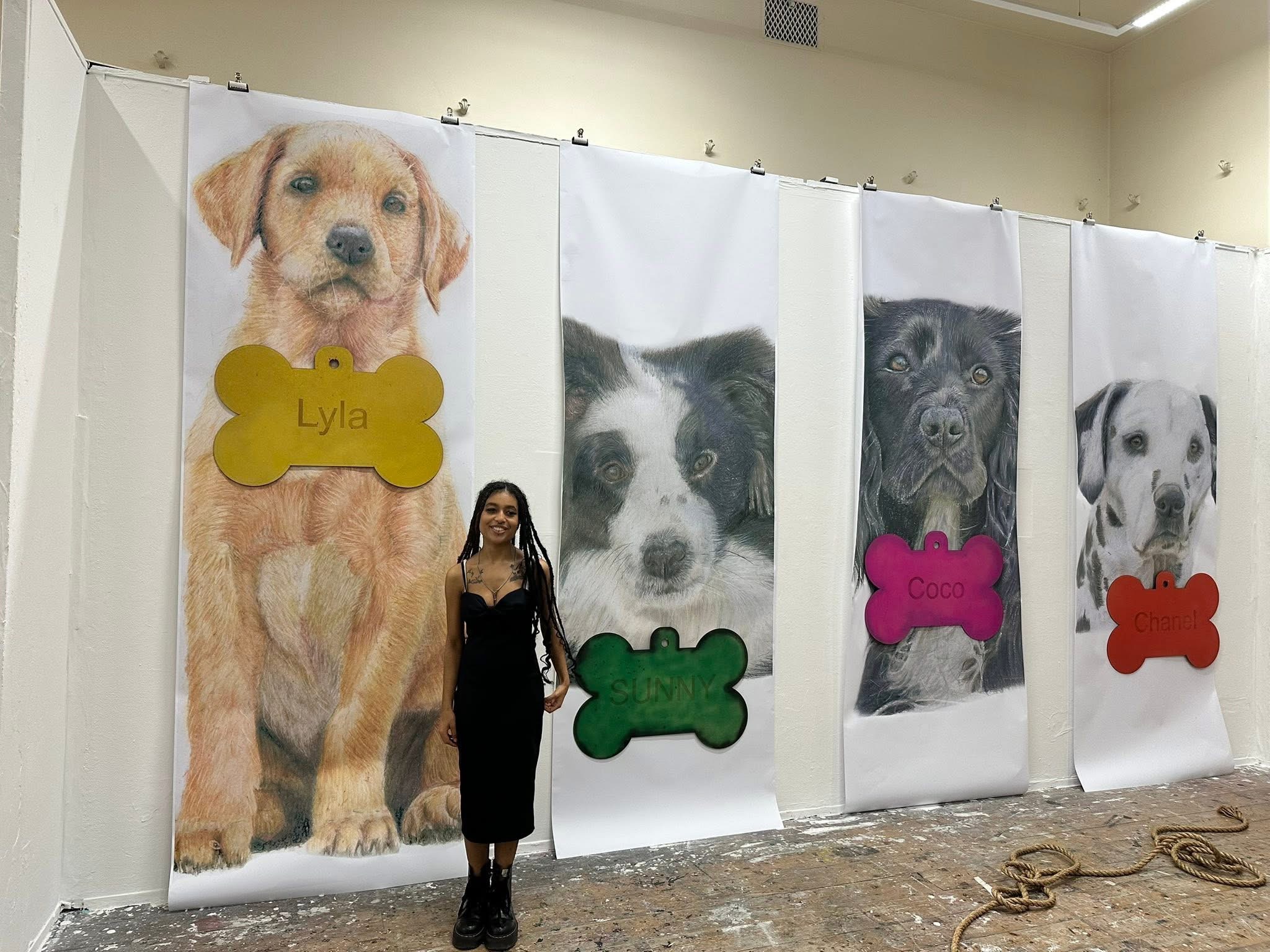
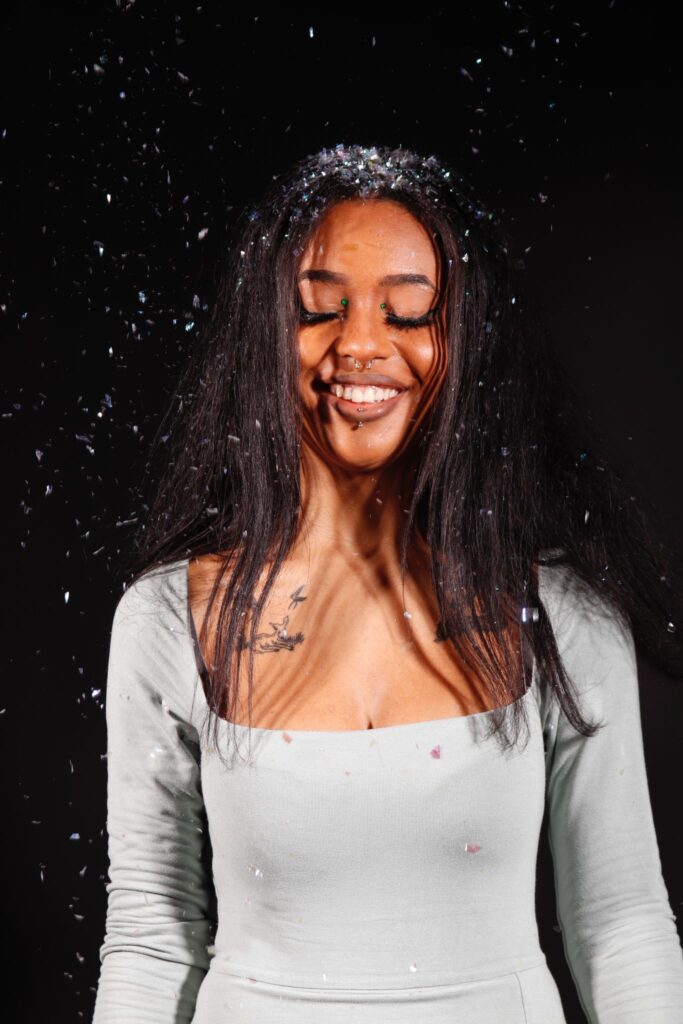
This is Leticia! She’s 22 years old and has recently finished her art degree at Birmingham University.
Her professional Artist statement is written below and was featured in her art degree show catalogue:
Leticia is an artist based in Northamptonshire and Birmingham. She creates coloured pencil drawings of animals and uses this as motivation to look into animal perspective and phenology. Inspired by Donna Haraway’s The Companion Species Manifesto. Her most recent exhibition, “Eyes on You,” explores how scale can show this perspective in a funny way to the audience. Her work aims to bring the focus on the interpersonal relationship between dogs and humans and our intertwined reliance on one another. The artist also indulges in other processes, like photography, to convey this to the world.
Leticia’s journey as an artist began as a personal passion alongside her love of arts and crafts as a child. She started by drawing and recreating images from photographs and other artists’ work, which helped her develop an understanding of shapes, values, and observation. What truly inspired her to pursue art was seeing the incredible work created by other artists and realising that this was a creative space she wanted to be part of. Their talent and achievements motivated her to develop her own skills and follow her passion for art.
Leticia is specialised in pet portraits and we asked her what inspired her to become an artist where she brings pets to life on paper. Her response was “As with all artists, it’s inspired by the things around the culture surrounding you, and also your own thoughts and feelings. In my instance, in terms of pet portraits, I think animals have always been something that has been a strong influence in my life. My uncle in used to own a farm in a Scotland, and I would wake up to dogs inside the house and outside of it . He had 14 dogs in total alongside sheep, cats, ferrets and horses. It’s extended as an influence in my outlook and in my artwork too.”
Leticia’s favourite pet portrait is the black spaniel she completed most recently. She particularly loves this piece because the coloured pencil work allows the subtle purple undertones beneath the black fur to show through beautifully. Drawing on her understanding of colour theory, she explains that both black and white reflect and contain hints of other colours, which adds depth and realism to the artwork. This portrait showcases her attention to detail and her ability to capture the richness and complexity of colour in her subjects.
Much of Leticia’s other artwork has also been photography-based. Throughout her artistic practice, she has explored a wide range of themes, including The Handmaid’s Tale, feminism and feminist artists, gender identity, commentary on artificial intelligence, and the contrasting concepts of fast and slow. Her work often uses photography as a medium to examine contemporary issues and encourage reflection on the world around us.

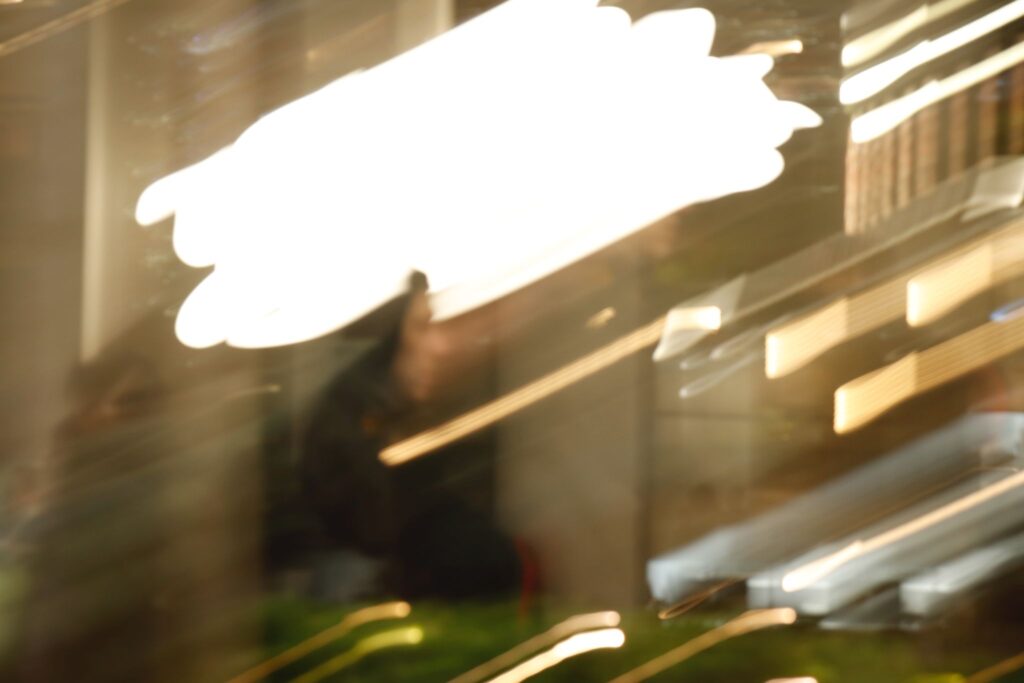
The theme of fast and slow
Leticia: “In these photos above, I explore the theme of fast and slow by using higher and lower apertures to show the fast and slow theme. I did this by doing two different photoshoots – one that featured moving objects with a blurry fashion and the other shows being frozen in time as I used a lower aperture on the camera.”
University Journey
Leticia has been studying for a BA (Hons) Fine Art degree. She was drawn to the course because of her ambition to become an art therapist. She chose Birmingham School of Art specifically because of its rich history and inspiring environment. Established in 1843, the building is full of character and natural light, providing a creative and motivating space in which to study and develop her artistic practice.
We asked Leticia ‘Looking back, what has been the most rewarding part of your university experience?” and she answered “The most rewarding part of being in university and at art school itself is being able to be in a space with other artists and getting challenged on my ideas and artwork.”
We also asked Leticia “What challenges have you faced during your studies, and how did you overcome them?“. Her response has shown what it can feel like struggling as a university student. The challenges Leticia has faced during art school have often been practical ones. Many of her more ambitious ideas have required extensive research, problem-solving, and self-funding to bring them to life. Alongside her studies, she has also had to navigate the financial pressures that many students face, with student loans often falling short of covering accommodation costs. Balancing a busy part-time job in a bar with the demands of her degree has required resilience and strong time-management skills.
University life has also brought its share of social challenges, from adapting to living with a variety of different people to dealing with unexpected events such as fires and break-ins. While not always positive experiences, these moments have all contributed to her journey and are memories she knows she will carry with her long after graduation.
Through her time at university, Leticia has learned that creative spaces are where she feels most at home and where she wants to build her future. Alongside developing as an artist, she has grown significantly as a person, gaining confidence, learning practical life skills such as cooking, and becoming more comfortable being herself. Her experiences have also helped her better understand her own values, teaching her the importance of setting boundaries and being mindful of the people she chooses to surround herself with socially.
Degree show
For Leticia, taking part in her degree show was an incredibly rewarding and memorable experience. After years of developing her practice, researching ideas, and creating work, having the opportunity to exhibit her pieces to the public felt like a significant achievement. One of the aspects she enjoyed most was celebrating the success of her classmates. She believes that being genuinely happy for others and recognising their accomplishments does not diminish her own achievements. Instead, it creates a supportive and inspiring creative community where everyone can learn from one another and appreciate the hard work that has gone into each exhibition.
The degree show also gave Leticia the opportunity to see people engaging directly with her work. Watching visitors spend time looking at her pieces, discussing their interpretations, and providing feedback was both exciting and encouraging. Hearing different perspectives helped her understand how audiences connected with her ideas and reinforced the value of sharing art with others. The experience motivated her to continue creating and exploring new concepts, reminding her that exhibiting work can be just as important as making it. For Leticia, the degree show was not only a celebration of what she had achieved so far, but also an inspiration to keep making, experimenting, and developing her practice in the future.
The pieces Leticia chose to exhibit were connected to a theme she had developed independently, focusing on animal perspective and the ways in which animals experience the world around them. Her research drew upon animal phenomenology and theory, exploring how animals perceive their environments through their own unique sensory experiences. She was particularly interested in understanding how animals see, hear, communicate, and interact with the world in ways that differ from humans.
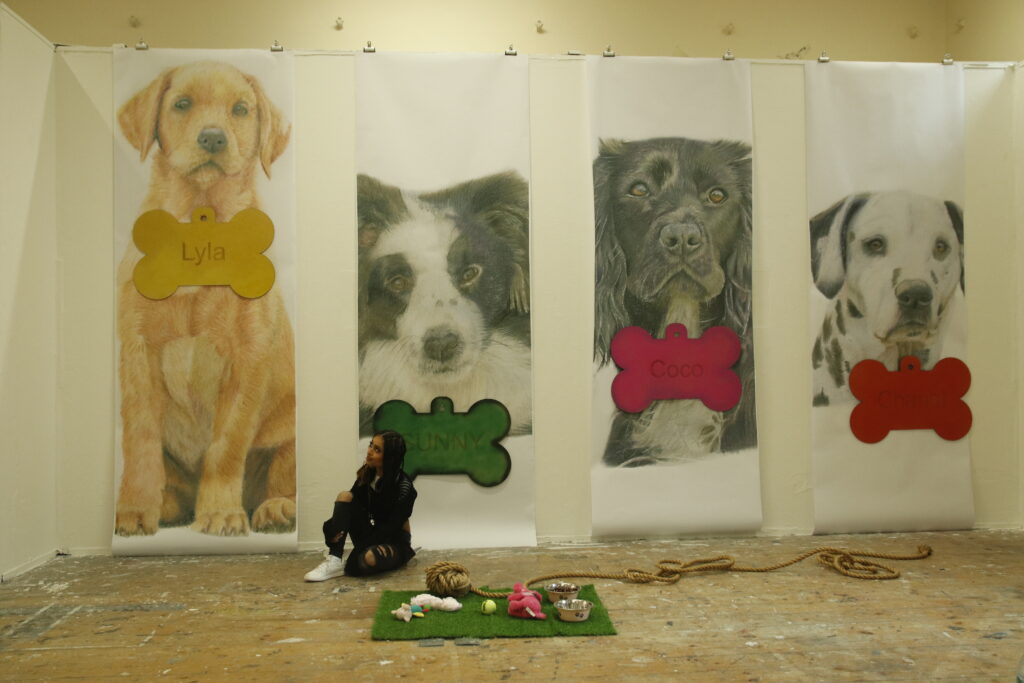
A significant area of her research centred on working dogs and the long-standing relationship between humans and dogs throughout history. She explored how humans and dogs have co-existed, worked together, and relied upon one another, as well as the important roles dogs continue to play in society today. Through this investigation, she became fascinated by the sensory experiences of dogs and how their understanding of the world differs from our own.
Leticia also looked at the work of artists and exhibitions that explored similar themes, helping her to develop her own creative approach. One unexpected influence was the children’s television programme Bluey, which incorporates colours based on those that dogs are believed to see. This inspired her decision to feature a golden retriever within her work, allowing her to further investigate canine vision and perception. By combining academic research, artistic influences, and her own interests, Leticia created a body of work that encouraged viewers to consider the world from an animal’s perspective and reflect on the unique ways in which animals experience their surroundings.
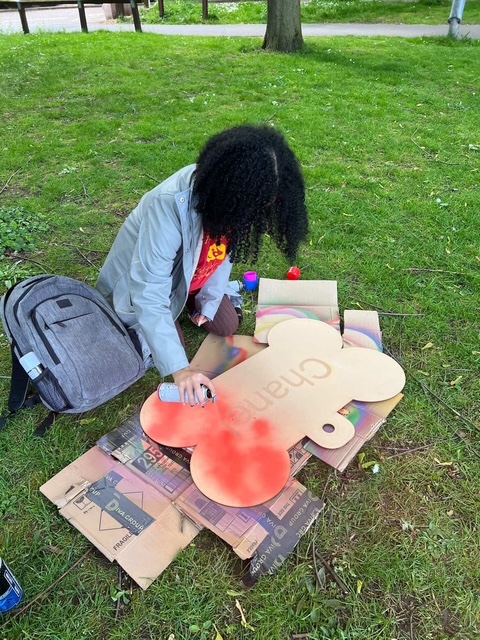
“The pieces I decided to showcase include those working dog breeds, and I used scale to show an animal perspective. It makes you feel as though you, as the viewer, is the dog that we are trying to understand through my work.”
Creativity and Inspiration
Another question we asked Leticia was “What does a typical creative process look like for you?”. It was nice to visualise how Leticia comes up with an idea for her artwork.
A typical creative process for Leticia starts with a topic she has interest in, and then she mind maps ideas as she believes it has to be broad and will extend on this with research by using books, websites and articles she finds. She then looks into other artists who have similar ideas in mind as her to see if there’s any improvements that could be considered. After all of this research, Leticia will have a better understanding of if the project is doable and will then extend her ideas from there onwards.
The pets I have drawn have had their own unique marks and quirks about them, and sometimes after I’ve been told a brief description of the them; I can feel and see the personality of the pet. Some of the animals I have drawn have sadly passed on and I’m able to bring them back to life through my drawings.
When asked what advice she would give to someone considering a career in art, Leticia’s response is simple: go for it. She believes that art is for everyone and that creativity should not be limited by ideas of perfection. In her view, not all art needs to be technically flawless, have perfect proportions, or strive for realism. What matters most is the message, emotion, or idea that an artist is trying to communicate.
Leticia is passionate about the idea that there is no single “right” way to create art. The art world is incredibly diverse, encompassing everything from traditional painting and drawing to photography, performance art, installation work, sculpture, and digital media. Each artist finds their own way of expressing themselves, and every creative approach has value.
She encourages aspiring artists not to compare themselves too heavily to others or feel discouraged if their work does not fit conventional expectations. For Leticia, the most important ingredient is passion. If someone is driven to create, experiment, and share their perspective with the world, then what they are making is art. She believes that creativity comes in many forms and that artists should embrace their individuality, trust their ideas, and have the confidence to pursue the work that excites and inspires them.
Looking ahead
Looking towards the future, Leticia would love to turn her artwork into a full-time career eventually. However it isn’t something that is feasible for her currently. She would love to have her own studio one day, but at the moment she does not have the funds to make this happen. Leticia is keeping positive and hoping that her dreams will become a reality in the future.
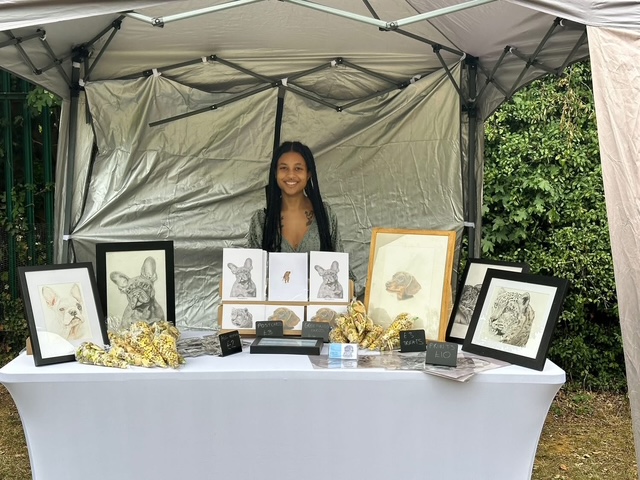
Leticia has said “Over the next few years, I will first take my gap year before I do my ultimate goal of becoming an art therapist, and I want to engage and help more vulnerable communities in Birmingham to help with this goal. For example, I want to extend the project that I did for my degree show on animal perspective and look into helping the homeless with assistance dogs, because if you have been given an assistance dog, why would you give up those tools that help you cope?”
Leticia has applied to do the open art competition in Birmingham – if you want more information or want to apply too, you can find it here. She has applied for an internship and a fellowship (at the same school of art she studied at) to go back as an artist in resident. She says “Hopefully it helps me to extend my project I mentioned with the homeless and assistance dogs, or engage in new and different communities and maybe gain a bit of manager experience (through the internship).
A more personal ending
Leticia had a really inspiring answer to our question “What does success mean to you?“. She explained “Success in the art industry isn’t always black and white. Sometimes it is someone appreciating your work, and then interacting and having ideas that you would never have thought of. It is vital for an artists developmental for constant feedback and criticism, good or bad, in order to grow as an artist”. This shows that art isn’t always as easy as people make it out to be. It is a talent that grows with progression, criticism and support, and not every person is cut out to do this as a career. You need to have strength and not take things personally – note every bit of feedback down and let it help you grow.
We also asked Leticia if she had a piece of advice for her younger self. Her advice was simple… “If I could give my younger self a piece of advice would be to keep doing exactly what you’re doing. You will eventually find your people and the space you’re meant to be in”.
And last but not least, we asked Leticia “What message would you like to share with other women pursuing creative careers?“
She replied with “I would tell other women pursuing creative careers to keep going! We need more of you out there, especially in this age where we have AI coming up and we don’t know what our jobs will look like for us or our future generations”.
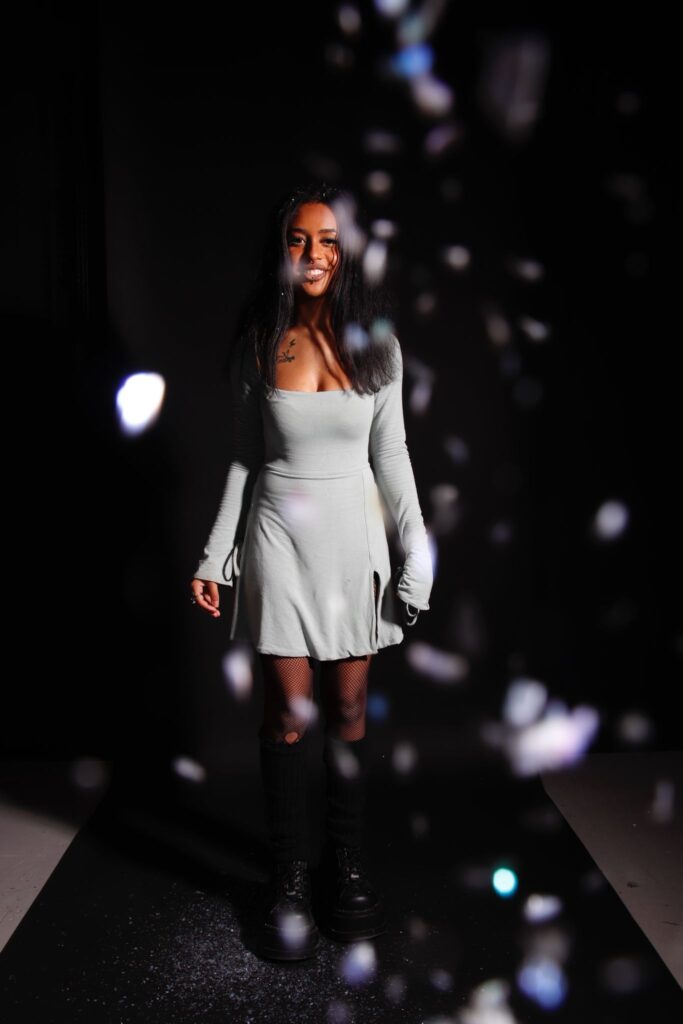
You can find and support Leticia on social media. If you would like her to draw any of your pets, we at The Go Girl Society have personally had portraits drawn for us and we LOVE how they turned out – so drop her a message to see if she can create something on paper for you too!
Instagram – @printsbyleticia
Facebook – Add Printsbyleticia23